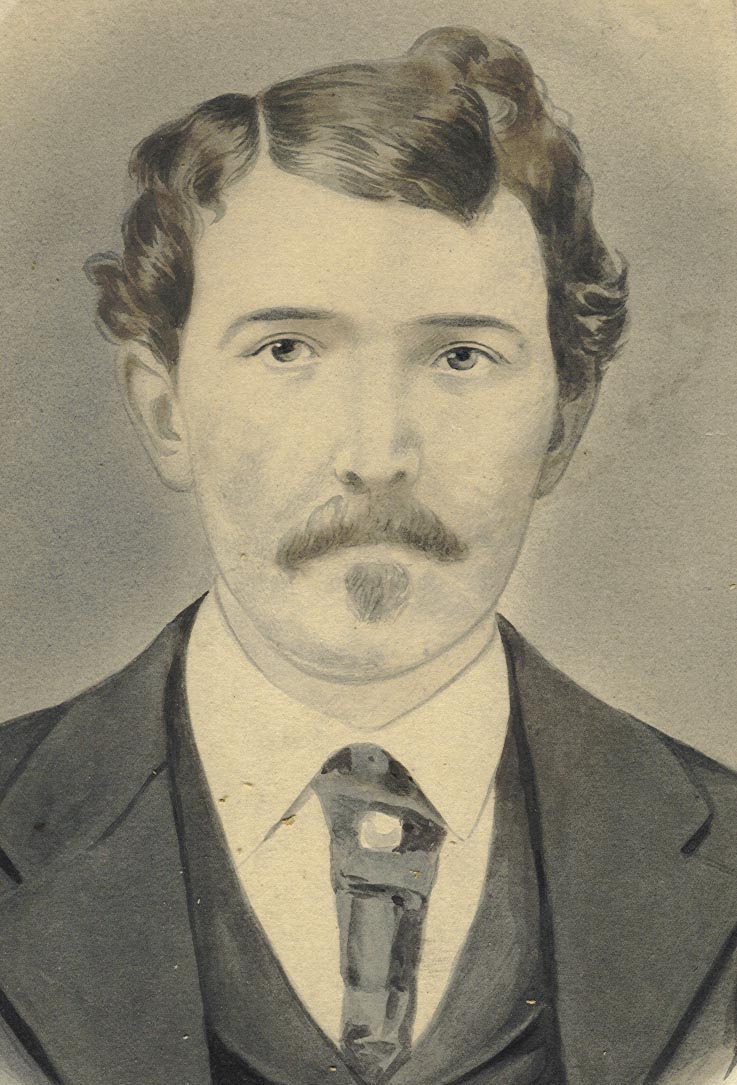
Patrick Madigan

Patrick Madigan
Sketch made of Patrick Madigan c1890

About Patrick Madigan and Bridget Thompson

About Patrick Madigan and Bridget Thompson

Patrick Madigan and his wife were both born in Ireland. Patrick was born April 1, 1850 in Coonagh, Killeely Civil Parish, County Limerick, Ireland, the son of Patrick Madigan (c1809-1884) and Margaret Fitzgerald (c1806-1886). Bridget, known for most of her life as Bessie, was born October 8, 1852 most likely in or near Limerick City, County Limerick, Ireland, the daughter of John (Thompson) Thomas (1831-1904) and Bridget Reidy (1831-1900). They both immigrated with their families to Chicago, Patrick in 1872 and Bridget in 1866. They married at Old St. John Church in Chicago on February 24, 1878. Together, they had seven children: Mary (Mayme) (1879-1955); Ellen [Sullivan/Madigan Blog] (1880-1966); Nanette (1881-1963); Thomas (1883-1898); Patrick (Harry) (1885-1956), John (1887-1983); and, James (1890-1909). Patrick was a laborer who died January 15, 1890 when he was only 39 and just a few months before the birth of his last child. Bessie ran a grocery store while raising the seven children as a single parent. She managed to own her own home on the west side of Chicago. She died from myocarditis on December 31, 1935.
Showing posts with label Capone. Show all posts

Wednesday, December 4, 2013

Hanging Prosecutor


The story behind the night Billy McSwiggin was killed in front of The Pony Inn:

"Back in Chicago at the beginning of 1926, Capone was in excellent spirits. Not only had he made his mark in New York, but his whiskey deal would change the face of interstate transportation. Young men with a thirst for adventure and the need for money made a good living working as one of Capone's truckers.

Klondike O'Donnell
"In the spring of 1926, Capone's run of good luck hit a snag. On April 27, Billy McSwiggin, the young "hanging prosecutor" who had tried to pin the 1924 death of Joe Howard on Capone, met with an accident. He left the home of his father, a veteran Chicago police detective, and went with "Red" Duffy to play cards at one of Capone's gambling joints. A bootlegger named Jim Doherty picked them up in his car.

"Doherty's car broke down and they hitched a ride with bootlegger "Klondike" O'Donnell, a bitter enemy of Capone. The four Irish lads went on a drinking binge in Cicero with O'Donnell and his brother Myles and ended up at a bar [this would be The Pony Inn operated by Harry Madigan] close to the Hawthorne Inn where Capone was having dinner. O'Donnell's cruising around in Cicero was a territorial insult.

"Capone and his henchmen, not realizing that McSwiggin was in the bar with Myles O'Donnell, waited outside in a convoy of cars until the drunken men staggered out. Then out came the machine guns and McSwiggin and Doherty were dead.

"Capone was blamed. Despite the blot on McSwiggin's integrity for keeping company with bootleggers, sympathy was with the dead young prosecutor. There was a big outcry against gangster violence and public sentiment went against Capone.

"While everyone in Chicago just knew that Al Capone was responsible, there was not a shred of proof and the failure of this high-profile investigation to return an indictment was an embarrassment to local officials. Police took out their frustrations on Capone's whorehouses and speakeasies which endured a series of raids and fires."

Source: Al Capone: Chicago's Most Infamous Mob Boss, by Marilyn Bardsley, Criminal Minds and Methods. http://www.trutv.com/library/crime/gangsters_outlaws/mob_bosses/capone/hang_13.html

Photo Source: AP

Thursday, November 10, 2011

Murder at 5615 W. Roosevelt - 1929

SLAIN IN CICERO SALOON

"William J. Vercoe, 51 years old, a credit expert who recently ventured into business for himself and met reverses, was shot to death last night at the bar of the Pony Inn cafe, 5615 Roosevelt road, Cicero.  Machine gunners killed Assistant State's Attorney William H. McSwiggin three years ago in front of the same resort, which was operated then, as it is now, by Harry Madigan and Michael Wendel.

"Hours after Vercoe died, when the county highway police had found no clues in the victim's apparently respectable past nor obtained enlightening statements from various witnesses, they declared there was only one credible theory in the murder.

"'What probably happened was that Vercoe strayed into a tough spot and spoke out of turn,' said Chief William Collins of the highway police.

Policemen Hear Shot

"Two highway policemen, James Howe and Eugene Majors, heard a single shot from the saloon as they rode past at 6:30 p.m.  Finding front and rear doors locked and observing a number of persons clambering out of the windows, they pursued two of the fugitives, who identified themselves as Wendel, one of the owners, and George McNally, the bartender.

"Inside they found the Negro porter, William Johnson. Bloodstains led from the bar to a stairway, where Vercoe's body, with a bullet wound behind his left ear, lay.

"McNally said Vercoe and two companions came in fifteen minutes before the shooting.  He served them a round of beer and busied himself at the bar until he was called to the women's parlor in the rear when he heard the shot, McNally said.

Attempt to Hide Body

"Wendel, who claimed he was in his office adjacent to the barroom at the moment of the shooting, joined him in attempting to remove the body, McNally said.  They dragged it to concealment, cleared the place of customers, locked the doors from the inside, and fled through windows.  Both men professed they had never seen Vercoe's companions before last night.

"In the slain man's pockets were cards naming him as president of the Vercoe Fuel Oil corporation, 711 (3?)1 South California avenue, and listing one Paul Freeland, 808 East 49th street, as vice president.  Freeland is Vercoe's son-in-law.

"Freeland said Vercoe purchased the oil company, an $80,000 concern, last February, and was lately attempting to obtain capital to rehabilitate it.  Mrs. Vercoe, he said, had been sent to Kankakee Insane asylum fourteen months ago, and Vercoe had frequented Cicero saloons since then, playing cards and endeavoring to interest his barroom acquaintances in the oil company.

"At the Rybski home it was said that for two weeks Reichel had been importuning Rybski daily to go with him to look at an automobile, but Rybski could not find time from his work to do so.  Yesterday morning about 10 o'clock, Miss Rybski said Reichel called for her brother and they left together 'to see that machine.'  He was not seen alive by the family after that.

"At the detective bureau, Reichel was grilled until late this morning.  He steadfastly denied that he had written the extortion notes."

Saloon in Front of which McSwiggin was killed again murder scene
"Madigan's Pony inn at 5615 West Roosevelt road, in which William J. Vercoe was found shot to death behind bar.  William H. McSwiggin, assistant state's attorney, was killed in front of the saloon, where the crowd is gathered."


Source: Chicago Daily Tribune (1872-1963); March 20, 1929; ProQuest Historical Newspapers Chicago Tribune (1890-1984), page 2.  Photo back page of newspaper.

EDITOR'S NOTE:  This is a most peculiar report in the Chicago Tribune.  In the last sentence of the article "what" extortion notes are they talking about?  The whole story just sounds rather bizarre.

Overview of McSwiggin and Capone Relationship

The following Blog post from The Chicago Crime Scenes Project gives a "sanitized" version of the events of the night of April 27, 1927.

"William McSwiggin was Assistant States' Attorney in Chicago, and had vigorously pursued an indictment against Al Capone in 1924 for killing Joe Howard in a South side bar.  While unable to successfully prosecute Capone (despite the presence of several eye-witnesses), McSwiggin became known as a "hanging" prosecutor.  But there was more to him than met the eye.

"McSwiggin was also a card player, gambler, and drinker, and that naturally brought him into close contact with Capone and his associates on a regular basis.  In fact, with the passage of time, Capone began to consider McSwiggin a friend.  One night in late Spring, 1926, after dinner at his parents' house, McSwiggin and a few close friends went out for a night of gambling and drinks.  Shortly after leaving the house, their car broke down and they ended up joining a couple of other friends in their car. These friends were the O'Donnell brothers, rival bootleggers who had a growing feud with Capone.

"The O'Donnells' shiny new Lincoln went cruising through Cicero with McSwiggin and friends, hitting bar after bar, until they ended up here, at the Pony Inn, not far from Capone's Cicero headquarters.  When word came to Capone that his rivals were encroaching on his territory, he sent a convoy of Lieutenants, armed with machine guns, to make his displeasure known. No one told him his friend McSwiggin was with the group.

"As the drinking party left the Pony Inn, bursts of gunfire sent fifty rounds into the group, killing three, including McSwiggin (the O'Donnells, the targets of the attack, escaped unharmed).
Public outcry at the gangland death of a state prosecutor pushed the police into action.  Chicago police invaded Cicero, arresting Ralph Capone and raiding several Capone-owned joints.  Al fled the city, spending the summer of 1926 among friends in the Italian community in Lansing, Michigan, until the heat died down enough for him to return to the Chicago area.

"Never again, however, was Capone completely unmolested by the police.  Though he had never intended to hurt McSwiggin, he had lost his standing with the public, who began to put increasing pressure on the police to shut down gang operations."

Posted by Kendall, The Chicago Crime Scenes Project: Photographs of locations associated with infamous criminal incidents in Chicago. Thursday, September 30, 2008.

McSwiggin Assassinated in front of the Pony Inn - 1926

The following are excerpts from several books on the assassination of William McSwiggin, Assistant State's Attorney of Cook County, in front of Harry Madigan's Pony Inn, April 27, 1926.  The excerpts give you some background and insight on what it must have been like in Chicago in the 1920s - a time when our Harry and John Madigan ran a saloon.

******************************************************************************

Al Capone: The Biography of a Self-Made Man, Fred D. Pasley, Ayer Co., 1987, page 128

"The debacle of the police department may be said to date from a triple machine-gunning the night of April 27, 1926, when there died William H. McSwiggin, assistant State's attorney of Cook County; Thomas Duffy, barber, beer peddler, and precinct captain in McSwiggin's faction of the Republican party, and James J. Doherty, gangster, who McSwiggin had previously prosecuted for murder, Doherty being acquitted.

"They were riding about together, for reasons never satisfactorily explained, visiting the saloons and speakeasies of Capone's West Side territory.  Duffy and Doherty were henchmen of the brothers Myles and Klondike O'Donnell, the guerrillas of the bootleg war, aligned sometimes with the O'Banions, again with the Capones, depending on the financial advantages presented -- but generally going it alone.

"They had had a sort of entente with Capone when he entered Cicero, but had called it off.  Now they were his bitter enemies and business rivals.  For months they had been muscling in on the West Side beer trade while he was busy with Weiss, Drucci, and Moran on the north.  One of the customers they had taken away from him was Harry Madigan at 5615 West Roosevelt Road, Cicero.

" 'When I wanted to start a saloon in Cicero more than a year ago, Capone wouldn't let me,' Madigan told Chief of Detectives Schoemaker. 'I finally obtained strong political pressure and was able to open.' "

*******************************************************************************

Capone: The Life and World of Al Capone, by John Kobler, New York, copyright 1971. Reprinted: Da Capo, a member of the Perseus Book Group, 2003, page 173

"Jim Doherty had driven only a few blocks when his engine began to sputter.  He left his car for repairs in a West Side garage, and the five men changed to Klondike O'Donnell's new Lincoln sedan.  A sixth man joined the party, Edward Hanley, a former police officer.  He drove.  They roamed Cicero for about two hours, drinking beer in several saloons.  Their last stop was Harry Madigan's Pony Inn at 5613 [sic] West Roosevelt Road.  A two-story, white brick building with a big weedy lot behind, it stood a mile north of Capone's Hawthorne Inn stronghold.

"Relations between Capone and the O'Donnells had deteriorated to the brink of open combat. The Irishmen grew daily bolder in their encroachments upon Capone's Cicero territory.  Harry Madigan later explained to Chief of Detectives Schoemaker how matters had stood: 'When I wanted to start a saloon in Cicero more than a year ago, Capone wouldn't let me.  I finally obtained strong political pressure and was able to open.  Then Capone came to me and said I would have to buy his beer, so I did.  A few months ago Doherty and Myles O'Donnell came to me and said they could sell me better beer than Capone beer, which was then needled.  They did and it cost fifty dollars a barrel, where Capone charged me sixty.  I changed, and upon my recommendation so did several other Cicero saloonkeepers.'"

*******************************************************************************

Capone: The Man and the Era, Laurence Bergreen, Simon & Schuster, 1994, page 164

"... [He did] not know that among the men accompanying "Klondike" O'Donnell was Billy McSwiggin, the prosecutor Al like to call his friend.  The 'rifle with a big round magazine' that Capone had bestowed on his associate was, of course, a machine gun.  Several other Capone henchmen joined the man who had warned Capone.  Together they walked to the back of the hotel, entered their waiting automobiles, and formed a five-car convoy consisting of a lead car, two cars following to block traffic if necessary, Capone's chauffeured limousine tailing at a distance of fifty feet, and finally another car well behind the limousine.  The convoy arrived within moments at the Pony Inn.  At half past eight, McSwiggin, Hanley, Doherty, Duffy, and the O'Donnell brothers staggered out of the Pony Inn, heading for the Lincoln and the next stop on their spree, and as they did so Capone and his men watched from the safety of their five-car convey.

"That was when McSwiggin's night on the town with the boys ended, and the nightmare of blood and terror began.  As McSwiggin's group came into view, Capone's gunmen let loose, and the unmistakable rhythm of a machine gun firing split the night.  Whether Al himself had fired any shots was not clear, and it would soon become the matter of impassioned debate.  As the convoy rolled past, the victims fell to the street; the entire attack had taken only seconds to execute, and over fifty shots had been fired. ('I saw a closed car speeding away with what looked like a telephone receiver sticking out the rear window and spitting fire,' said one elderly witness of her first look at a machine gun in action." Red Duffy, his body nearly cut in two by the bullets, and Jim Doherty were gravely wounded.  The O'Donnell brothers and Edward Hanley were lucky to survive; they had reacted quickly enough to dodge the hail of bullets.  As for Billy McSwiggin, the 'hanging prosecutor' whom Al Capone had called his friend, he was writhing on the sidewalk, his body riddled with twenty bullets lodged in his back and neck.

"Fearing another attack, the O'Donnell brothers hastily dragged Duffy to a tree and left him. ('Pretty cold-blooded to leave me lying there,' he remarked just before he died the following day.)  They then carried Doherty and McSwiggin to their Lincoln sedan and sped to "Klondike's" house on Parkside Avenue.  By the time they arrived, both McSwiggin and Doherty were dead.

"Panicking, the O'Donnells hauled the bodies inside, removed the contents of their pockets, ripped the labels from their clothes, as if these precautions would change anything, and returned the corpses to the car.  The O'Donnells drove away from the city and its lights to the black prairie extending from the outskirts of Berwyn.  They came to a halt along a deserted stretch of road, shoved the remains of McSwiggin and Doherty out the door, and fled.  At ten o'clock that night, the driver of a passing car noticed the bodies.  He stopped to investigate and discovered they were still warm."

Wednesday, November 9, 2011

Crime of the Century - 1926

A website, Homicide in Chicago, 1870 - 1930, has recently been created.  Under "Crimes of the Century," information on the 1926 Capone vs. McSwiggin case is included.  Of note with this case is that the murder took place in front of Harry Madigan's tavern in Cicero, Illinois.

Helen Sullivan McIntyre, niece of Harry Madigan, said her mother, Nell Madigan Sullivan, as well as her mother's sisters and her grandmother, Bessie Thompson Madigan, were all "mortified" when the murder occurred and the Madigan name was in all the newspapers.

Harry always denied any involvement with the mafia and evidence that either he or his partner in the tavern were convicted of any wrong doing has yet to be located.  However, there seems to be quite a bit of information implicating Harry, and sometimes John Madigan, with involvement with various Chicago gangs.  See also a previous posting on this site: Harry Madigan, 1885 - 1956.

On the Homicide in Chicago website is a photo of Harry's tavern at 5615 W. Roosevelt.  A Tribune newspaper account of the murder is also included.  Images from this site are reproduced below.  To enlarge any image, double click twice on it.

Tribune front page Wednesday, April 28, 1926


Article on front page


Photo of Harry Madigan's saloon at 5615 W. Roosevelt Road

Source: Homicide in Chicago, 1870 - 1930

Saturday, March 13, 2010

Harry Madigan, 1885-1956


Harry Madigan has a colorful past. A tavern owner up to and through prohibition he was involved in several incidents related to Chicago mafia corruption. Although never convicted, some of the stories seem to convey  possible connection with Al Capone, et. al. For a short summary of one of the incidents view Homicide in Chicago, 1870 - 1930.

During the investigation into the murder of Assistant State's Attorney of Cook County, William McSwiggin, in front of Harry Madigan's tavern, Harry is quoted in the book Capone: The Life and World of Al Capone by John Kobler saying: "When I wanted to start a saloon in Cicero more than a year ago, Capone wouldn't let me," Madigan told Chief of Detectives Schoemaker.  "I finally obtained strong political pressure and was able to open.  Then Capone came to me and said I would have to buy his beer, so I did. A few months ago Doherty and Myles O'Donnell came to me and said they cold sell me better beer than Capone beer, which was then needled.  They did and it cost fifty dollars a barrel, where Capone charged me sixty.  I changed, and upon my recommendation so did several other Cicero saloonkeepers."

Patrick Harry Madigan was born March 8, 1885 at 3644 Dashield, the fifth child of Patrick and Bessie Madigan.  Harry married late in life to Margaret Saunders, nee McHugh.  They married at Chicago's Mount Carmel Church on February 25, 1945 when Harry was 59 years old.  Harry died on November 27, 1956 of arteriosclerotic heart disease.  He is buried at Calvary Cemetery with his mother Bessie and two single brothers James and Thomas in Lot 15, block 6, section Z.

MADIGAN
--Harry P. Madigan of 221 S. Central Park avenue, beloved husband of Margaret Saunders Madigan, nee McHugh; brother of Nell Sullivan, Nan Rooney, John J., and the late Mayme Harvison (sic). At funeral home, 17 Madison street, Oak Park. Funeral Saturday, Dec. 1, 9:30 a.m., to Our Lady of Sorrows church. Mass 10 a.m. Interment Calvary. Member of Pipe Fitters union, local No. 597.
Chicago Tribune, November 30, 1956

Posted by Picasa