Bill Sullivan found a contemporary video of 5615 W. Roosevelt Road, Cicero, the building where Harry Madigan ran his saloon in 1926 and the site where Assistant States Attorney William McSwiggin was assassinated. Although the building looks a little different from the newspaper photo of it in 1926, the Cook County Assessor's website notes the building at 5615 W. Roosevelt Road is 96 years old. So, it must be the same. Thanks Bill for finding this.
Included on the You Tube webpage below the above video, the following comment was included:
"Assistant States Attorney William McSwiggin had two sides to him and it ended up costing him his life. By day he was known as a hanging prosecutor who tried to bring Al Capone to justice. By night he was a card player, drinker and all around bon vivant who traveled in the same social settings as the men he prosecuted. It was late spring in 1926 when he was out for a night of carousing in Cicero with some friends. Along the way the hooked up with the O'Donnell brothers who were well known north side gangsters who were at odds with Al Capone. Al Capone got word that his enemies were out and about in his town he dispatched gunmen to take them out. They caught up with the group at the Pony Inn on Roosevelt Rd. just west of Central. The Pony was a Capone controlled speakeasy that was run by an Irish mobster named Harry Madigan. Madigan was a member of the renowned Irish gang Reagan's Colt's. He would later go to jail for kidnapping and extortion. Anyway the gunmen raked the group with machine gun fire as they left the club. Three were killed including McSwiggin the O'Donnell brothers escaped unscathed. Here we present the Pony as it looks today a nondescript place called Sarno's. Maybe it's just a coincidence or perhaps things haven't changed much. Last year Cicero crime boss Michael Sarno was sentenced to prison in a case that involved extortion, illegal gambling, police corruption and a bombing. The more things change?"
Source: ChiTownView's Channel, YouTube
*******************************************************************************
However, in The Illinois Crime Survey published by the Illinois Association for Criminal Justice in cooperation with The Chicago Crime Commission, 1929 (Blakely Printing Company, Chicago) Chapter XXIV, "The Gangster and the Politician," Section 9, "Same: Election Violence," page 1005 it reads:
"Ragen members could be secured to do "stong arm" work in the elections in other districts as well as the stockyards area. Hugh McGovern with John and Harry Madigan and John O'Brien kidnapped a Cicero clerk of election by the name of Joseph Rice and held him prisoner in a West Harrison Street saloon. The plaintiff charged kidnapping and assault to kill. The history of the trial of these four men is an interesting sidelight on the administration of the law. True bills were voted by the April grand jury in 1924. The case did not come up for trial until June, 1926. Critics of State's Attorney Crowe, who was elected in the primaries of 1924 when so much violence was used in the elections, accused him of purposely shelving this case along with others that grew out of the 1924 elections. Just before the case was due to come to trial a new assistant prosecutor was assigned to it, in place of the one who had been familiar with the case from its inception. The men were acquitted of the charge although the defense had offered no closing argument and the assistant prosecuting attorney in charge had made only a brief summary of the case for the state. The prosecuting witness, who had positively identified his assailants as McGovern, the Madigan Brothers, and O'Brien two years before, refused in 1926 to say that these four were the kidnappers, and it was generally understood that it was for fear of his life."
So, although there seems pretty good evidence the Madigan brothers might have been guilty of kidnapping and extortion, the record of The Illinois Crime Survey indicates the men were acquitted. Also, to my knowledge, Harry Madigan was never "convicted" and sentenced to jail.
A little earlier in The Illinois Crime Survey, Chapter XVII, "The McSwiggin Assasination as a Typical Incident," Section 6, "The Federal Grand Jury Indicts Capone and the O'Donnells," page 836-837, it reads:
"While State's Attorney Crowe's grand jury was in session, primarily to consider the solution of the McSwiggin mystery, a Federal Grand Jury was busy investigating prohibition violations, with possible bearing on the murders of Duffy, Doherty and McSwiggin. United States District Attorney Edwin A. Olson, in charge of this Federal Grand Jury, was of the Deneen faction. Chief Svoboda, of the Cicero police, and Joseph Klenha, president of the village board, were summoned to appear.
"Federal agents had seized a stock of beer samples stored in the basement of the Cicero City Hall. It had been reported that immediately after the triple slaying, Cicero policemen had visited every saloon in the village and collected beer samples. According to the information given the Government on May 22, the police had told the saloon owners:
" 'There is going to be a big investigation. Don't tell anybody anything. If you open your faces these samples go to the prohibition office and your prosecution under federal statues is certain.'
"The Federal Grand Jury, on May 27, returned two indictments, naming the leaders of the two rival beer gangs, the Capone gang and the O'Donnells, charging conspiracy to violate the prohibition law. Those in the Capone gang who were indicted were Al Capone, Ralph, his brother, Frank Smith, Charles Fischetti and Peter Payette. The O'Donnell gangsters named were: William (Klondike), Myles, and Barnard O'Donnell, and Harry Madigan, the owner of the saloon where McSwiggin and his companions were killed."
Harry Madigan was indeed indicted due to violation of the prohibition law, However, in searching other documents, I have yet to find that Harry Madigan was convicted of any federal charges associated with these prohibition violations. But I'm still looking.
Patrick Madigan
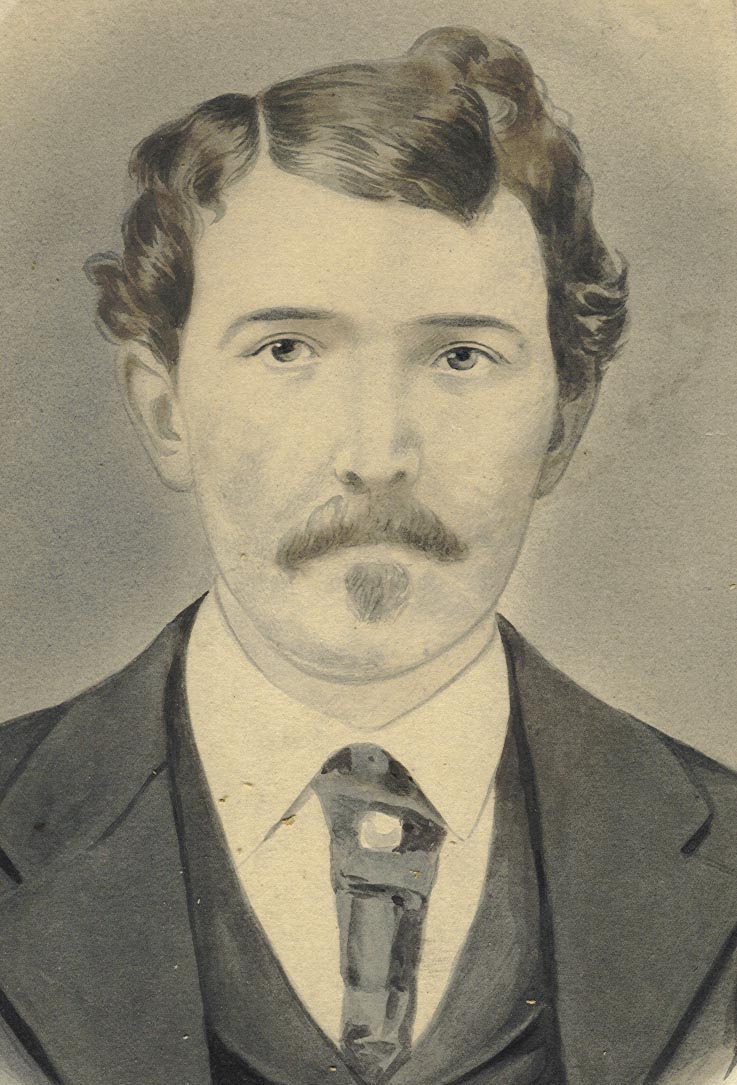
Sketch made of Patrick Madigan c1890
Wednesday, November 9, 2011

Crime of the Century - 1926
A website, Homicide in Chicago, 1870 - 1930, has recently been created. Under "Crimes of the Century," information on the 1926 Capone vs. McSwiggin case is included. Of note with this case is that the murder took place in front of Harry Madigan's tavern in Cicero, Illinois.
Helen Sullivan McIntyre, niece of Harry Madigan, said her mother, Nell Madigan Sullivan, as well as her mother's sisters and her grandmother, Bessie Thompson Madigan, were all "mortified" when the murder occurred and the Madigan name was in all the newspapers.
Harry always denied any involvement with the mafia and evidence that either he or his partner in the tavern were convicted of any wrong doing has yet to be located. However, there seems to be quite a bit of information implicating Harry, and sometimes John Madigan, with involvement with various Chicago gangs. See also a previous posting on this site: Harry Madigan, 1885 - 1956.
On the Homicide in Chicago website is a photo of Harry's tavern at 5615 W. Roosevelt. A Tribune newspaper account of the murder is also included. Images from this site are reproduced below. To enlarge any image, double click twice on it.
Source: Homicide in Chicago, 1870 - 1930
Helen Sullivan McIntyre, niece of Harry Madigan, said her mother, Nell Madigan Sullivan, as well as her mother's sisters and her grandmother, Bessie Thompson Madigan, were all "mortified" when the murder occurred and the Madigan name was in all the newspapers.
Harry always denied any involvement with the mafia and evidence that either he or his partner in the tavern were convicted of any wrong doing has yet to be located. However, there seems to be quite a bit of information implicating Harry, and sometimes John Madigan, with involvement with various Chicago gangs. See also a previous posting on this site: Harry Madigan, 1885 - 1956.
On the Homicide in Chicago website is a photo of Harry's tavern at 5615 W. Roosevelt. A Tribune newspaper account of the murder is also included. Images from this site are reproduced below. To enlarge any image, double click twice on it.
 |
| Tribune front page Wednesday, April 28, 1926 |
 |
| Article on front page |
 |
| Photo of Harry Madigan's saloon at 5615 W. Roosevelt Road |
Source: Homicide in Chicago, 1870 - 1930
Thursday, October 21, 2010
Tom Sullivan Remembers his Madigan Grandparents, Aunts and Uncles
Excerpts from "Notes About Things I Remember" by Thomas A. Sullivan, March 4, 1996.
Grandparents
I never knew my maternal grandfather. [He died in 1890.] My maternal grandmother [Bessie Thompson Madigan] ran a grocery store to raise her children. When I came on the scene she had retired and owned the two-flat on Fillmore St. When we moved she sold it and bought a two flat on Congress St. There she fell down the basement stairs and broke her hip, being confined to a wheel chair for the rest of her life. The congress highway came through so she sold out and bought a three-flat. Aunt May (Mary) and Mother took turns cleaning and attending her home. John and Harry lived with her. There was another girl, Nan, who lived in Denver.
Madigan Aunts and Uncles
Grandparents
I never knew my maternal grandfather. [He died in 1890.] My maternal grandmother [Bessie Thompson Madigan] ran a grocery store to raise her children. When I came on the scene she had retired and owned the two-flat on Fillmore St. When we moved she sold it and bought a two flat on Congress St. There she fell down the basement stairs and broke her hip, being confined to a wheel chair for the rest of her life. The congress highway came through so she sold out and bought a three-flat. Aunt May (Mary) and Mother took turns cleaning and attending her home. John and Harry lived with her. There was another girl, Nan, who lived in Denver.
Madigan Aunts and Uncles
- Mary (Aunt May) was very close to Mother. She lived on Flournoy St. with her husband, George Cooley, a post office executive, and his mother. Claude died a lingering death from "blood poisoning", before antibiotics. Burdette Harbison, a nephew of Mrs. Cooley, used to visit the sick [Claude] and after Claude died continued to visit. He and Aunt May eventually married and he moved in.
- Nellie (Mother) worked at Donnelly Bindery alongside of Laura (Margaret's Mother-to-be) before their marriages. I can't remember all her stories about my Father's courtship.
- Nanette (Aunt Nanny) Ruth's Mother married George Rooney, a Santa Fe executive who had an artistic flair. He was stationed in Denver and later in San Francisco. Ruth attended the Art Institute School in Chicago and when she graduated got a job there. When George died, Nan moved out from San Francisco to stay with Ruth whose roommate [Margaret Larsen] moved out and got married. Nan was a sweet and gracious lady.
- Harry (Patrick) was a steamfitter who went into the contracting business and lost his shirt in the great 1930 depression. He also was in the saloon business before and after the contracting business. The first saloon I remember was at 4700 W. Harrison. He had a number of politician and political hanger-ons as customers and was rumored to be involved with the prohibition rum-runners, etc. Later he had a saloon out in Cicero and an assistant states Attorney from Chicago was shot-down coming out of it. No executioners found. After this he started a family-type saloon on Madison Street just east of Crawford, and prospered. Had a second floor for private parties. His brother John worked days and Harry worked nights. The employees were very friendly but rumor had it they "stole him blind" particularly after he and John had a quarrel and John quit. As a result he failed, which along with the failure of his construction business earlier, left him broke and he went to work as a bartender in a Chicago suburb. Meanwhile Margaret Saunders' husband died, she was involved in a train crossing accident, lost a leg and she and Harry married. She got him out of the saloon business and he worked for the sanitary district as a steamfitter. He lived with her about 10 years. She was confined to a wheelchair. He told me he felt he was doing penance for his early life as a saloon keeper and his early relationship with Margaret. He was a man of substance and many of the important friends he had made through the years attended his funeral.
- John, the youngest, was without ambition. When he was drafted in WWI he managed to get into the entertainment side of the army and spent his time in Europe boxing to entertain the troupes. After the war he set up pins in a bowling alley, drove a truck for Uncle Harry's contracting business, and was a bartender at Harry's Madison Street saloon. He felt he was sort of assistant manager and built up quite a clientele at the bar in the afternoon, with free drinks. This could have caused the break up with Harry, but after he left the stealing started. He worked at a local saloon for a while then married Mary, Harry's cook and went to a place she had in Hayward, Wisconsin, where they lived on his army pension. When he was about 95 Johnny and I visited him, but that's another story. He died a couple of years later.
Friday, September 3, 2010
Ellen Madigan, Birth Certificate, 1880
 Ellen Madigan was born on May 29, 1880. She was the second child of Bridget Thompson and Patrick Madigan. She was born at home at 3644 Dashield and delivered by mid-wife, Anna Hay. Perhaps, given the midwife was named "Anna," it is the reason Ellen/Nell was "named" Anna on her birth certificate.
Tuesday, August 10, 2010
John J. Madigan Letter, 1972
John J. Madigan, son of Patrick Madigan and Bridget Thompson, wrote a letter to his nephew, Thomas A. Sullivan, on December 18, 1972. In the letter, John responds to a request from Thomas' grandson, John Sullivan, who had requested some genealogical information on John Madigan's parents.
I have reproduced the letter, from a copy received from John Sullivan, in its entirety. I received the copy sometime in the early 1990s. Twenty years later, John Madigan's memories have all been verified!


Note that two of the children of John Thomas and Bridget Reidy are not listed: Patrick (1857-b1866) and Marian/Mary (1865-b1866). It is believed they died in Ireland as young children and would not have been known to John Madigan, the letter's author. This letter also is posted on the Thompson/Reidy Genealogy Blog.
I have reproduced the letter, from a copy received from John Sullivan, in its entirety. I received the copy sometime in the early 1990s. Twenty years later, John Madigan's memories have all been verified!


Note that two of the children of John Thomas and Bridget Reidy are not listed: Patrick (1857-b1866) and Marian/Mary (1865-b1866). It is believed they died in Ireland as young children and would not have been known to John Madigan, the letter's author. This letter also is posted on the Thompson/Reidy Genealogy Blog.
Friday, July 16, 2010
The Origin of the Thompson and Madigan Names
There is so much information today on the web. I found, what appears to be some good history on both Thompson and Madigan names. Similar content was also located in The Dictionary of Irish Family Names by Ida Grehan.
Thompson
This famous name is one of the patronymic forms of the name Thom or Tom, diminutives of the male personal name Thomas. The given name is of Biblical origin, being an Aramaic byname meaning "twin", borne by one of Christ's disciples; in England the name Thomas was found only as the name of a priest before the Norman Conquest of 1066, but thereafter became one of the most popular male personal names, generating a wide variety of surnames. The patronymic forms from diminutives, such as Thomson (the Scottish form) and Thompson, found mainly in England and Northern Ireland, appear in the 14th Century, the first recording being from Scotland. The intrusive "p" of the English and Irish forms was for easier pronunciation, although there are two old wives tales that the 'p' meant 'prisoner', or in Ireland 'Protestant', both are incorrect. Examles of early recordings include John Thompson in the Charters of the Abbey of Whitby, Yorkshire, in 1349, and Thomas Tomson, who married Elizabeth Harris at the church of St Jon the Evangelist, Dublin, on December 12th 1631. The earliest Coat of Arms is probably the following granted in Yorkshire in 1559. Per fess silver and black, with a fesse embattled between three falcons counterchanged, belled, beaked and jessed in gold. The crest is an arm holding a gold truncheon . One of the very earliest settlers in the New World, was William Thompson recorded as 'living at Elizabeth Cittie, Virginea', before February 16th 1623. The first recorded spelling of the family name is shown to be that of John Thomson, which was dated 1318, in the "Annals of Scotland", during the reign of King Robert 1 of Scotland, known as "The Bruce", 1306 - 1329. Surnames became necessary when governments introduced personal taxation. In England this was known as Poll Tax.
Madigan
This is a famous Irish clan surname recorded as Madden, Madigan, and MacAvaddy. It derives from the pre-10th century Olde Gaelic O'Madain, translating as 'The descendant of the son of the hound'. Most Irish surnames originate from a chief's nickname, O'Kennedy, for instance means 'The descendant of the ugly headed one!' The O'Madain's originated from lands on the River Shannon in County Galway, at one time holding over 25,000 acres. Even today nameholders are still numerous in that part of Ireland. The Madigan branch of the clan are regarded as almost exclusively a Clare-Limerick family, although a branch are to be found in Counties Antrim and Derry in Ulster. Early surname holders included the Rev. Samuel Madden (1680 - 1760), a famed philanthropist, whilst Richard Madden, (1798 - 1886) was the author of the book 'The United Irishman'. During the infamous 'Potato Famine' of 1846, many name holders emigrated to both England and America. Amongst these were Walter Madden and his wife Mary, and their children Richard aged five and Alice, a baby. They sailed from Galway, bound for New York on the ship 'Junius ' on May 1st 1846. Another recording is that of Hannah Madigan aged twenty two, who left Belfast on the ship 'Howard' for New York, on July 23rd 1846. The first recorded spelling of the family name is believed to be that of Dermot O'Madadhain, which was dated circa 1100. He was chief of the Ui Maine, Connacht, during the reign of King Henry I st of England, known as 'The Just", 1100 - 1135. Throughout the centuries, surnames in every country have continued to "develop" often leading to astonishing variants of the original spelling.
Source The Internet Surname Database accessed June 5, 2010
Monday, June 14, 2010
Calvary Cemetery Past and Present


Initially, Calvary had a lagoon, which can be seen in the first photo above. Eventually, this was filled in to create a shrine section. Also, the main road which runs from Sheridan Road to Chicago Avenue, was flanked with Elm trees which were planted when the Cemetery opened. A hundred years later, in the 1960s, when Dutch Elm disease struck, they were cut down. A view of the original tree lined lane is seen above.
Patrick and Bessie (Thompson) Madigan are buried here as are three of their children, James, Thomas and Harry (Patrick). Also buried her are many members of the Sullivan and Connor families. For information on these families see Connor/Colfour Genealogy and Sullivan/Connor Genealogy blogs.
Today's main entrance of Calvary Cemetery is off of Chicago Avenue. Currently there are no new graves available.

Old photos courtesy Calvary Cemetery. Front gate photo, Elaine Beaudoin, 2010.
Subscribe to:
Posts (Atom)